On April 8, 2026, the BESIII Collaboration achieved a significant breakthrough in the study of electromagnetic radiative decays of excited hyperons: for the first time, the radiative decays of the excited states Λ(1520) and Λ(1690) into a photon (γ) and a Σ⁰ particles were observed. This result has been published in Physical Review Letters (Phys. Rev. Lett. 136, 141801 (2026)).
The Λ hyperon is a baryon containing a strange quark, and its excited states, Λ(1520) and Λ(1690), provide key opportunities for probing the strong interaction and understanding quark confinement. Electromagnetic radiative decay processes where a single photon is emitted, acting much like an "electromagnetic CT scan" of the particle and serve as a unique probe of its internal structure. However, due to the extremely rare nature of such signals, observing these decays has long been a considerable experimental challenge. Prior to this work, data on Λ(1520) → γΣ⁰ were absent, and such decay for Λ(1690) had never been seen.
Utilizing its enormous dataset of about 10 billion J/ψ events and leveraging the advantage of quantum-correlated hyperon-antihyperon pairs in the final states, the BESIII Collaboration, for the first time, observed clear signals from both Λ(1520) and Λ(1690) in the invariant mass spectrum of γΣ⁰. Both signals exceeded a statistical significance of 15 standard deviations, marking the first experimental discovery of these radiative decay channels for Λ(1520) and Λ(1690), respectively.
The experiment further measured the ratio of branching fractions for Λ(1520) decaying to γΛ compared to γΣ⁰, finding a value of 3.19. This result is consistent, within uncertainties, with the theoretical expectation based on quark flavor SU(3) symmetry, but notably excludes predictions from certain models such as the relativistic constituent quark model and algebraic models. Even more remarkable is the anomalous behavior of Λ(1690): unlike Λ(1520), while the decay to γΣ⁰ is clearly observed, no signal is seen for Λ(1690) → γΛ, with its upper limit less than 8% of the γΣ⁰ branching fraction. This striking difference in the radiative decay patterns of two similar excited states presents a new puzzle for understanding hyperon internal structure and poses a direct challenge to theoretical models describing light quark dynamics.
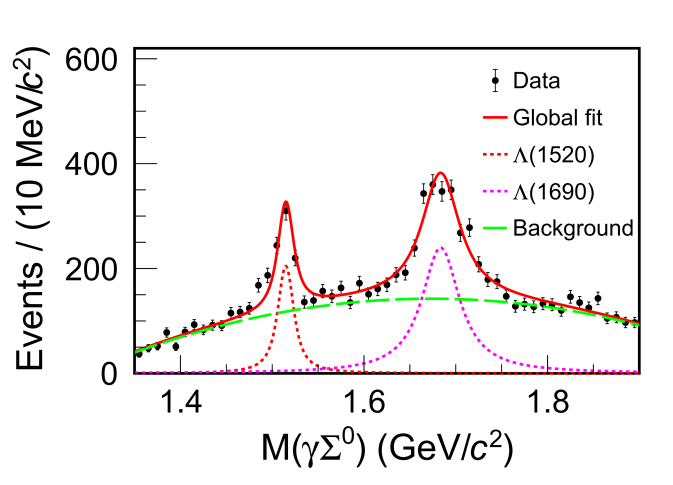
Fig. 1、γΣ⁰ invariant mass distribution and the fitting result.
