
The BESIII Collaboration has observed, for the first time, transverse polarization of the lightest charmed baryon, the Λ₊⁺, produced in electron-positron annihilation near the production threshold. The study also provides a systematic investigation of the production and weak-decay dynamics of the Λ₊⁺. The results have been published in Physical Review X under the title "Production and Decay Dynamics of the Charmed Baryon Λ₊⁺ in e⁺ e⁻ Annihilations near Threshold." This marks the first publication by the BESIII Collaboration in Physical Review X.
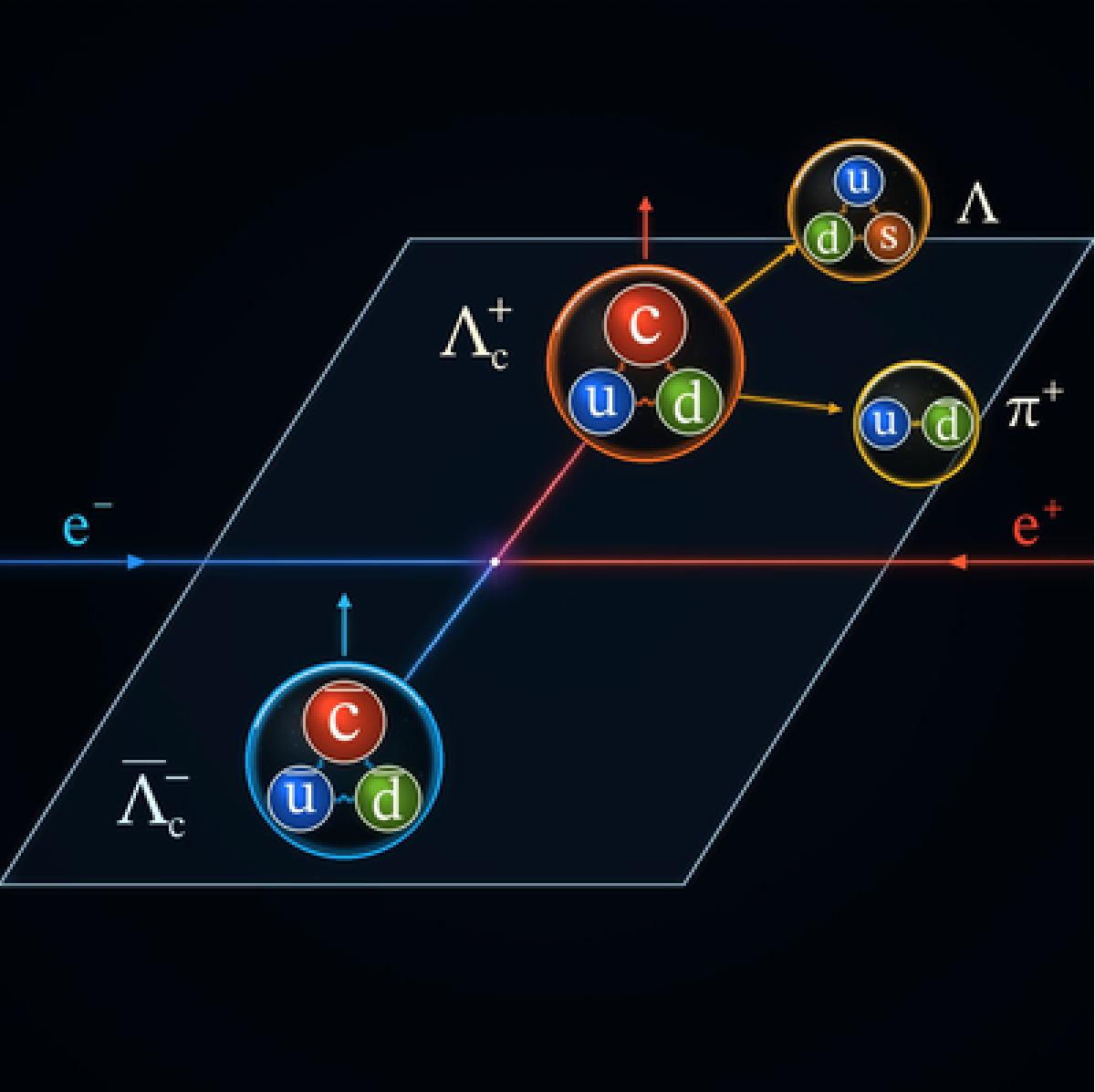
Baryons such as protons and neutrons are composed of three quarks and make up most of the visible matter around us. The electric and magnetic form factors, Gₑ and Gₘ, are important probes of the internal structure of baryons. The BESIII Collaboration had previously measured their magnitudes and ratio precisely near threshold, but the lack of information on their relative phase limited the development of relevant theoretical descriptions. In the production of charmed-baryon pairs through electron positron annihilation, a nonzero relative phase can, through quantum interference, induce transverse polarizations of the Λ₊⁺ and Λbar₊⁻ perpendicular to the production plane, as illustrated in Figure 1. Precise measurements of this transverse polarization provide a new dimension of experimental constraints on baryon structure and dynamics in systems involving a heavy quark, as well as on the production mechanism and spin formation, thereby deepening our understanding of nonperturbative strong-interaction dynamics.
The analysis is based on electron-positron annihilation data collected with the BESIII detector at center-of-mass energies from 4.60 to 4.95 GeV. It establishes transverse polarization of the Λ₊⁺ for the first time and extracts the relative phase between its electric and magnetic form factors. In an innovative approach, the team selected five weak-decay modes as polarization analyzers and incorporated the electromagnetic production process and decay dynamics into a unified framework. Despite the limited Λ₊⁺ event yields, the overall statistical significance exceeds 10 standard deviations.
The study also determined the Lee-Yang parameters of four two-body weak-decay modes and achieved the world's most precise measurements to date of strong-phase parameters in Λ₊⁺ → Σ⁰ π⁺ and Σ⁺ π⁰. In addition, CP symmetry in charmed-baryon weak decays was tested, with no evidence of CP violation observed. These results are important for understanding baryon-production mechanisms, internal structure, and spin structure, and they demonstrate the potential of transverse polarization as a tool for studying charmed-baryon production, decay, and CP violation.
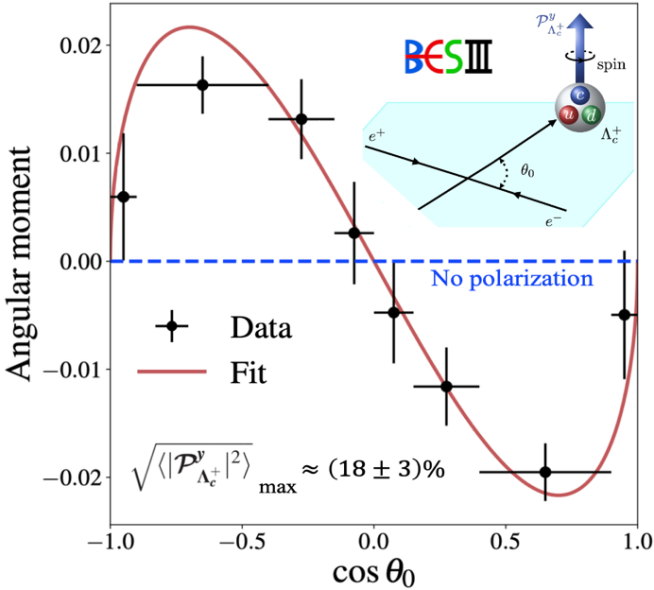
Figure 2: Measurement of transverse polarization. The blue dashed line denotes the no-polarization hypothesis.
Article link:https://journals.aps.org/prx/abstract/10.1103/5v2c-55m1