
The BESIII Collaboration has achieved the first complete determination of the spin density matrix in the decay ψ(3686) → Λ Λbar, providing a unified experimental framework for studying both hyperon production dynamics and quantum correlations. The study has been published in Science Bulletin.
Hyperons provide a unique laboratory for spin physics because their parity-violating weak decays act as natural spin analyzers. In the process ψ(3686) → Λ Λbar, the angular distributions of the proton and antiproton from the subsequent Λ and Λbar decays retain information about the polarization and spin correlations of the hyperon-antihyperon pair.
Using (448.1 ± 2.9) million ψ(3686) events collected with the BESIII detector, the BESIII Collaboration performed a five-dimensional joint angular analysis of the full decay chain ψ(3686) → Λ Λbar → p π⁻ p̄ π⁺. Unlike previous studies based on partially integrated angular distributions, the analysis provides direct access to the complete spin structure of the Λ Λbar system.
The analysis determines the angular-distribution parameter to be α_ψ = 0.82 ± 0.02 (stat.) ± 0.01 (syst.) and, for the first time in this decay, measures the relative phase between the production amplitudes, ΔΦ = (20.6 ± 3.6 (stat.) ± 0.6 (syst.))°. The nonzero phase gives rise to a transverse polarization of the Λ hyperon. Its maximum value is measured to be P_y = 0.074 ± 0.013 (stat.) ± 0.003 (syst.), with a significance of 6.3σ relative to the non-polarization hypothesis.
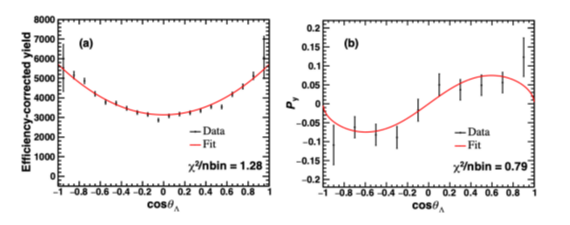
[Figure 1: Angular distribution and transverse polarization of the Λ hyperon.]
Beyond providing information on the hyperon production mechanism, the complete spin density matrix makes it possible to quantitatively investigate quantum correlations in the Λ Λbar system. The BESIII Collaboration extracted the spin-correlation coefficients and evaluated both Wootters' concurrence, which quantifies quantum entanglement, and the Bell nonlocality measure m₁₂ associated with the Clauser-Horne-Shimony-Holt (CHSH) inequality.
The average Bell nonlocality measure is determined to be m₁₂ = 1.266 ± 0.078 (stat.) ± 0.049 (syst.). For local hidden-variable theories, the CHSH condition requires m₁₂ ≤ 1. A likelihood-ratio test using toy Monte Carlo samples gives a 3.7σ significance for the violation of the CHSH inequality, providing evidence for quantum nonlocality in the Λ Λbar system produced in vector charmonium decay.
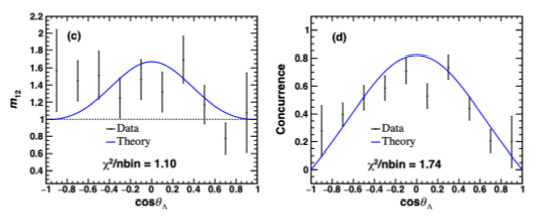
[Figure 2: Bell nonlocality measure m₁₂ and Wootters' concurrence as functions of cos θ_N. The dashed line indicates the CHSH bound m₁₂ = 1.]
The measured production parameters also provide new information on the dynamics of hyperon-antihyperon production. Within the covariant L-S framework, the BESIII Collaboration extracted the relative S- and D-wave contributions and compared them with those in other charmonium decays. Differences observed between Λ Λbar and Σ⁰ Σ̄⁰ production suggest that spin observables are sensitive to the internal spin-flavor structure of hyperons.
This study demonstrates that the complete spin density matrix provides a common framework connecting two complementary aspects of fundamental physics: the strong-interaction dynamics governing baryon-antibaryon production and the quantum correlations between the produced particles. The results establish ψ(3686) → Λ Λbar as a powerful laboratory for studying hyperon production dynamics, internal spin structure, and quantum entanglement in a system of massive baryons.
Reference
BESIII Collaboration, First determination of the full spin density matrix in ψ(3686) → Λ Λbar, Science Bulletin (2026). DOI: 10.1016/j.scib.2026.09.056