
The BESIII Collaboration has observed the spin‑2 strange meson K₂(1430)⁻ in the semileptonic decay D⁰→K⁻π⁰e⁺νₑ for the first time with a significance of 7.9σ. The first amplitude analysis performed on this decay reveal a tiny D‑wave contribution of the K₂(1430)⁻ in the K⁻π⁰ system, accounting for (0.157±0.056ₛₜₐₜ±0.042ₛᵧₛₜ)% of the total decay rate. This result establishes a new benchmark for understanding how the strong interaction shapes the production of light hadron in weak decays. This work has been published in Physical Review Letters [Phys. Rev. Lett. 137 191903 (2026)].
The strong interaction, described by quantum chromodynamics (QCD), binds quarks together to form hadrons such as protons and neutrons. While QCD can be treated perturbatively at high energies, understanding its non‑perturbative dynamics at lower energies, where the internal structure of hadrons emerges, still remains a major challenge. Semileptonic charm decays provide a particularly clean environment to investigate these non‑perturbative dynamics. In these decays, a charm quark transforms into a strange quark via the weak interaction, while strong‑interaction effects govern the formation and evolution of the final‑state hadronic system. These effects are encoded in hadronic form factors, which provide an essential link between experimental measurements and theoretical predictions.
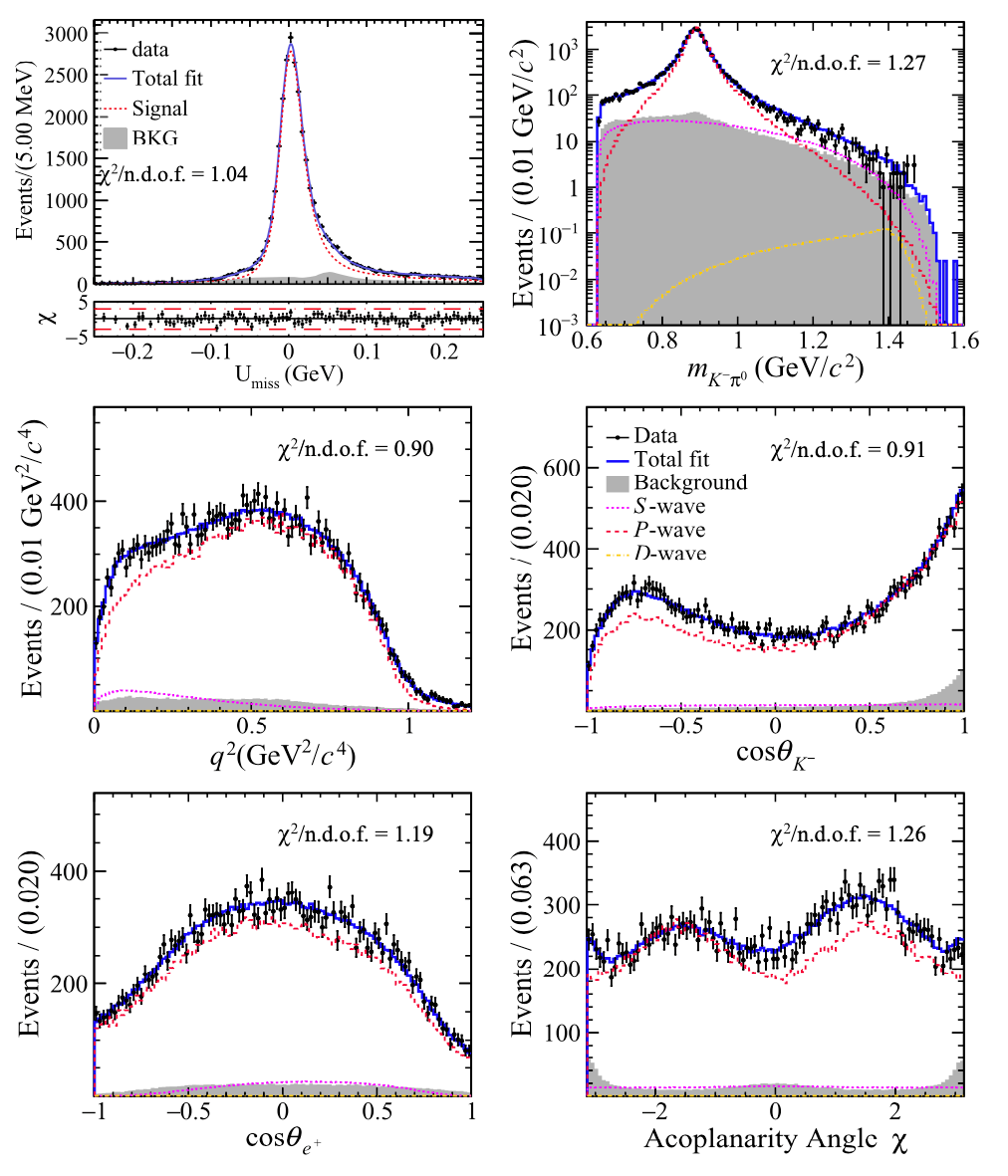
Figure 1. The data and fits for Uₘᵢₛₛ and the projections onto the five kinematic variables; the dots with error bars represent the data, the blue curves indicate the total fit, and the filled gray histograms show the background contributions.
Using a data sample corresponding to an integrated luminosity of 20.3 fb⁻¹, collected at a center‑of‑mass energy of 3.773 GeV, the BESIII Collaboration has performed the first amplitude analysis of the semileptonic decay D⁰→K⁻π⁰e⁺νₑ. Besides a tiny D‑wave observation, the hadronic form factors of the dominant P‑wave D⁰→K*(892)⁻ transition are measured precisely as rᵥ=V(0)/A₁(0)=1.432±0.050ₛₜₐₜ±0.017ₛᵧₛₜ and r₂=A₂(0)/A₁(0)=0.786±0.037ₛₜₐₜ±0.027ₛᵧₛₜ. The branching fraction of D⁰→K*(892)⁻e⁺νₑ with K*(892)⁻→K⁻π⁰ is measured to be (7.445±0.061ₛₜₐₜ±0.048ₛᵧₛₜ)×10⁻³. Combining the measurements of the D⁰→K*(892)⁻(→K⁻π⁰)l⁺νₗ, lepton flavor universality is tested by the ratio RLFU=B(D⁰→K*(892)⁻μ⁺νμ)/B(D⁰→K*(892)⁻e⁺νₑ)=0.928±0.020ₛₜₐₜ±0.012ₛᵧₛₜ with unprecedented precision and no violation found. Furthermore, isospin symmetry in the K*(892)⁻ decay is tested by RK*- = B(K*(892)⁻→K⁻π⁰)/B(K*(892)⁻→K⁰Sπ⁻) =1.087±0.013ₛₜₐₜ±0.009ₛᵧₛₜ for the first time using the latest measurement of D⁰→K*(892)⁻e⁺νₑ with K*(892)⁻→K⁰Sπ⁻, which indicates that isospin‑breaking effect in the K*(892)⁻ decay may need to be reconsidered. The isospin‑breaking effect in this decay is usually ignored for a long time. Theoretically, it is naively expected to be at most a few percent but has never been tested experimentally since the K*(892) discovery in 1961. Finally, the phase shift of the Kπ S‑wave is extracted in a model‑independent way, which provide a valuable new input for investigating the properties of the elusive K*₀(700), whose underlying nature still remains a puzzle.
Journal publication: Phys. Rev. Lett. 137, 191903 (2026)
DOI: https://doi.org/10.1103/ngfq‑f3t7‑f3t7
arXiv: https://arxiv.org/abs/2603.00743