
The BESIII collaboration has reported the study of "First Measurement of the Ds⁺ → K⁰μ⁺νμ Decay, Study of Dynamics and Test of Lepton Universality with Ds⁺ → K⁰νμ Decays". The relevant results have been published in Physical Review Letters on 25 November 2026. [Phys. Rev. Lett. 137, 221801 (2026)].In the standard model (SM), semileptonic (SL) decays of charmed mesons provide valuable information on the weak and strong interactions with hadrons composed of heavy quarks. The partial rate of the decay is related to the product of the hadronic form factor (FF) describing the effects of the strong interaction in the initial and final hadrons, and the Cabibbo-Kobayashi-Maskawa (CKM) matrix element |Vcd| parametrizing the mixing of quarks in the weak interaction. Due to |Vcd| being tightly constrained by CKM unitarity, studies of Ds⁺ meson cabibbo-suppressed SL decay provide an ideal laboratory to extract the hadronic FFs associated with the Ds⁺ → K⁰ transition. In theory, calculations of the form factors in the Ds⁺ → K⁰ transition are extensively performed by a series of non-perturbative approaches. However, the calculated FFs from these theories differ significantly. Precise measurements of the FFs can provide stringent tests and rigorous calibrations on various non-perturbative calculations.
In this Letteri, using 7.33/fb of e+e- annihilation data collected at 4.13-4.23 GeV with the BESIII detector, we report the first complete study for the Ds⁺ meson cabibbo-suppressed SL decays Ds⁺ → K⁰μ⁺νμ and Ds⁺ → K⁰e⁺νe. We measure the branching fractions (BFs) of positron and muon SL decays to be (0.207±0.022±0.010)% and (0.214±0.018±0.010)%, respectively. And the relative ratio of the BFs between muon and positron modes are determined to be Rμ/e = 0.97±0.13±0.04, which provides a validation of the lepton flavour universality (LFU) predicted by the standard model in the Ds⁺ → K⁰ transition.
In addition, based on a partial wave analysis (PWA) of the dynamics, we report the most precise determination of the FF parameters in the Ds⁺ → K⁰ transition. We measure the FF parameters to be rV = V(0)/A1(0) = 1.63±0.14±0.08 and r2 = A2(0)/A1(0) = 0.60±0.13±0.06, as well as A1(0)=0.56±0.02±0.01 at the q²=0, where V(0) is the vector FF and A1,2(0) is the axial FF. At a confidence level of 95%, the measured BFs disfavor the central values calculated with the theoretical calculations in LCSR, CLFQM, and CCQM. The measured r2 and rv disfavor the central values calculated in CLFQM, and the measured A1(0) disfavors the central values calculated in LCSR and hQCD. In particular, the significant deviation of the LCSR calculation in Ref. [Phys. Rev. D 111, 113005 (2025)] with respect to our measured A1(0) suggests big theoretical challenges when theory incorporates contributions of meson distribution amplitudes with higher-twist corrections.
Furthermore, we also provide the first model-independent measurement of the partial decay rates and forward-backward asymmetries in both the full and binned four-momentum regions in Ds⁺ → K⁰l⁺νl decays. These results presented in this Letter provide powerful tests and constraints on various theoretical calculations, especially in QCD theories, and play an important role in understanding the dynamics of SL decays of 417 charmed hadrons in the nonperturbative region
Reference: Phys. Rev. Lett. 137, 221801 (2026)
Journal link: https://doi.org/10.1103/flqh-zxzr
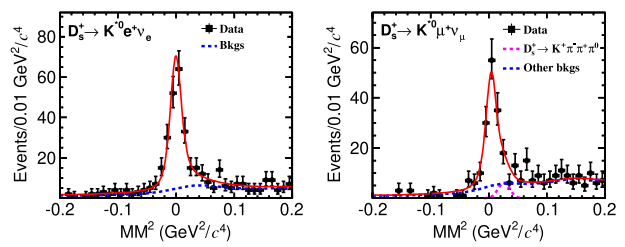
Figure 1: The missing-square (MM²) distributions for positron and muon SL decays.

Figure 2: Comparisons of the measured (left) BFs, (middle) rv and r2, and (right) A1(0) for the Ds⁺ → K⁰ transition with various theoretical calculations.

Figure 3: The (left) partial decay rate and (right) forward-backward asymmetries measured in data for Ds⁺ → K⁰l⁺νl decays, with various theoretical calculations.